


Same-Day Dental Implants in Albania: 24-Hour Teeth (2026)
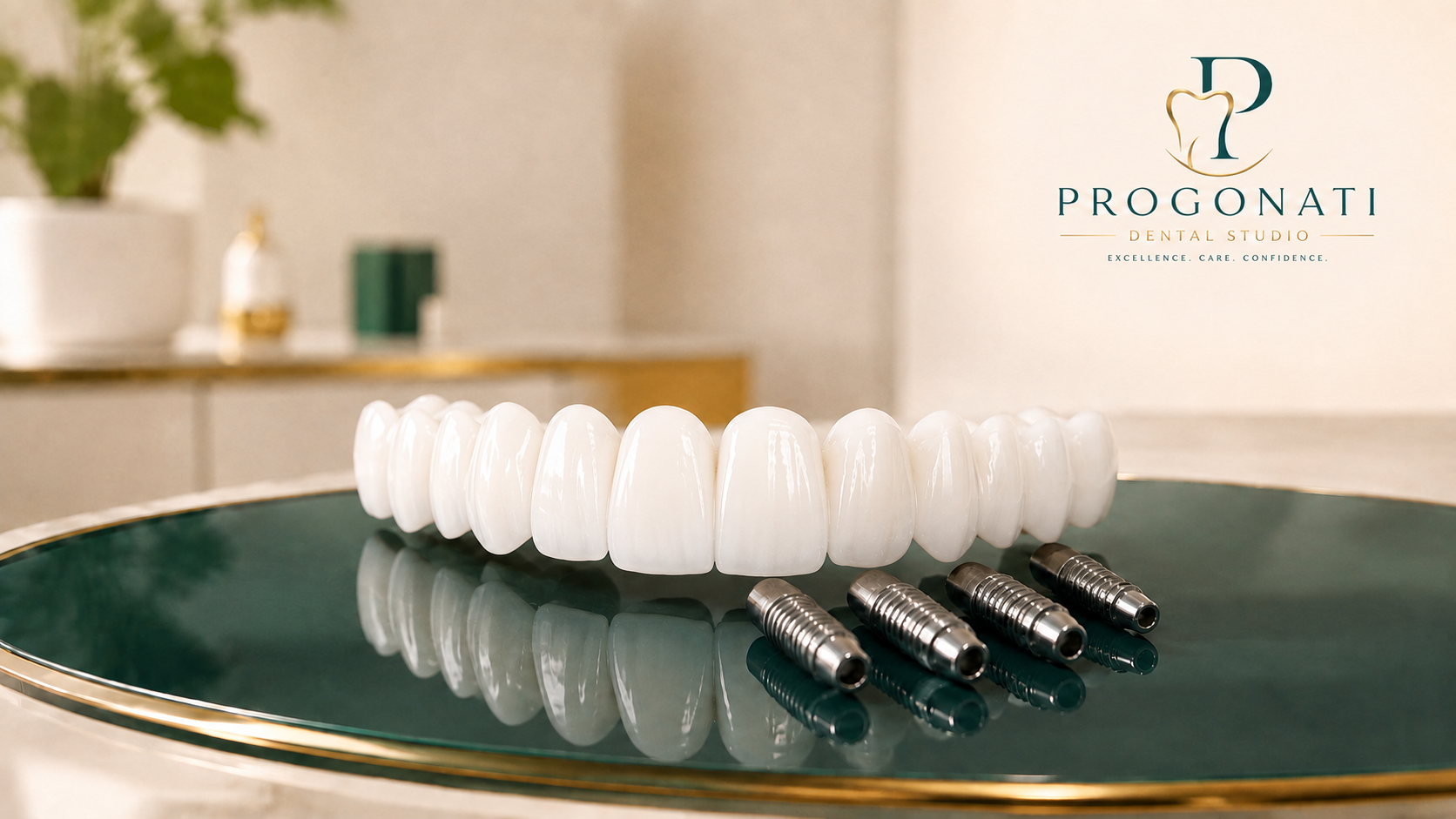
Getting fixed teeth within 24 hours may sound impossible. However, modern implant dentistry can allow selected patients to receive a fixed temporary restoration shortly after dental implants are placed.
This treatment is commonly advertised as “teeth in a day”, “same-day dental implants” or “fixed teeth in 24 hours”. These phrases can be useful, but they must be understood correctly.
In most cases, the teeth fitted immediately are a carefully designed temporary fixed bridge, not the definitive restoration. The implants still need time to integrate with the jawbone, and the final teeth are normally produced after the healing phase.
At Progonati Dental Studio in Fier, Albania, every immediate-loading case is evaluated individually by Dr Lorenc Progonati. The decision depends on bone quality, implant stability, gum health, bite forces, general health and the design of the future restoration.
Yes, fixed teeth within 24 hours may be possible for selected patients.
The treatment normally involves placing dental implants and connecting them to a fixed temporary bridge on the same day or within approximately 24–72 hours. This protocol is known as immediate loading.
However, immediate loading is not suitable for everyone. The implants must achieve sufficient initial stability, and the temporary teeth must be designed to protect them while the surrounding bone heals.
The definitive zirconia or ceramic restoration is usually fitted several months later, after successful osseointegration.
- Same-day implants and immediate fixed teeth are related but different procedures.
- “Teeth in 24 hours” normally means a fixed temporary restoration.
- The implants still require several months of biological healing.
- Adequate bone and strong initial implant stability are essential.
- A 3D CBCT scan is necessary for accurate planning.
- All-on-4 or All-on-6 does not automatically guarantee immediate teeth.
- Smoking, active gum disease, uncontrolled diabetes and severe teeth grinding may increase risk.
- Many international patients require two trips to Albania.
- The treatment plan may need to change if sufficient implant stability is not achieved during surgery.
- No responsible clinic can guarantee teeth in 24 hours before completing the necessary clinical and radiographic assessment.
What Are Same-Day Dental Implants?
The expression “same-day dental implants” can refer to several different clinical situations.
It may describe:
- removing a damaged tooth and placing an implant during the same surgical appointment;
- placing an implant and attaching a temporary crown shortly afterwards;
- removing multiple compromised teeth, placing several implants and fitting a fixed temporary full-arch bridge within 24–72 hours.
These procedures are not identical.
An implant can be placed immediately after an extraction but left without a fixed tooth during healing. Alternatively, an implant may be placed into an already healed area and connected to a temporary restoration immediately.
For this reason, patients should always ask what a clinic means when it advertises “same-day teeth”.
Immediate Implant Placement and Immediate Loading: What Is the Difference?
These two terms are frequently confused.
Immediate implant placement
Immediate implant placement means that the dental implant is inserted into the extraction socket during the same appointment in which the tooth is removed.
This approach can reduce the number of surgical stages in suitable cases. However, placing the implant immediately does not automatically mean that a fixed tooth can also be fitted immediately.
Immediate loading
Immediate loading means connecting the implant or implants to a restoration shortly after surgery.
According to the International Team for Implantology, immediate loading occurs when implants are connected to a prosthesis that participates in the bite within one week of implant placement.
The immediate restoration may be:
- a temporary crown for one missing tooth;
- a temporary bridge for several teeth;
- a fixed full-arch provisional bridge supported by four, five or six implants.
Immediate placement and immediate loading can sometimes be combined, but only when the clinical conditions make this approach safe.
Are Teeth Fitted Within 24 Hours Permanent?
Usually, no.
The bridge fitted immediately after implant surgery is generally a provisional restoration. It provides appearance, speech and controlled function while the implants heal.
This temporary stage also allows the dental team to evaluate:
- tooth length and shape;
- smile line;
- facial and lip support;
- speech;
- bite relationships;
- comfort;
- cleaning access;
- the patient’s aesthetic preferences.
After osseointegration, the implants, gums and bite are reassessed. New digital scans or impressions may then be taken to produce the definitive restoration.
The final fixed bridge is designed according to the healed implant positions, gum contours, facial proportions and long-term functional requirements.
Therefore, “teeth in 24 hours” should not be interpreted as completing every surgical and prosthetic stage permanently in one day.
How Does the Treatment Work?
1. Preliminary assessment before travelling
International patients can begin their treatment journey remotely.
For an initial assessment, patients may send:
- a recent panoramic X-ray or CBCT scan;
- clear photographs of their teeth and smile;
- information about missing, loose or damaged teeth;
- previous dental treatment plans;
- details of medical conditions and medication;
- information about smoking;
- preferred travel dates.
This information helps the dentist estimate whether immediate loading may be possible and how many treatment stages could be required.
However, a remote review cannot confirm final suitability. The treatment plan must be verified through a clinical examination and appropriate three-dimensional diagnostics at the clinic.
2. Clinical examination and 3D planning
Before implant surgery, the dentist evaluates:
- which teeth can be preserved;
- the condition of the gums;
- the presence of infection or periodontal disease;
- bone height, width and quality;
- the position of nerves and maxillary sinuses;
- the relationship between the upper and lower jaws;
- bite forces;
- signs of grinding or clenching;
- smile line and facial proportions;
- the intended position of the final teeth.
A CBCT scan provides three-dimensional information about the jawbone and important anatomical structures.
Digital scans, clinical photographs and bite records may also be used to plan implant positions and design the temporary restoration.
The implants must be positioned according to the future teeth. Implant surgery and prosthetic design should never be planned as separate treatments.
3. Tooth extractions and implant placement
Teeth that cannot be predictably saved may be removed.
In appropriate cases, implants can sometimes be inserted during the same appointment. The surgeon then evaluates the stability of every implant.
Primary stability describes how firmly an implant is held by the bone immediately after placement. It is one of the most important requirements for immediate loading.
If the implants do not achieve sufficient stability, attaching a fixed bridge may create excessive movement during early healing.
In that situation, changing to a conventional healing protocol is not a failure. It is a responsible decision intended to protect the implants and improve long-term predictability.
4. Production of the fixed temporary teeth
When immediate loading is clinically appropriate, digital or conventional records are used to produce the provisional bridge.
The temporary restoration must:
- fit the implants accurately;
- distribute forces safely;
- provide controlled bite contacts;
- allow adequate hygiene;
- support speech and facial appearance;
- protect the implants during healing;
- remain repairable if adjustments are required.
Progonati Dental Studio has an in-house dental laboratory, allowing direct collaboration between the dentist and dental technicians during the design, production and adjustment stages.
This coordination is particularly valuable for full-arch treatment, where function, appearance and implant protection must be managed together.
5. Healing and osseointegration
Receiving fixed temporary teeth does not mean that the implants have completed healing.
Osseointegration is the biological process through which the implant develops a stable connection with the surrounding bone. This process normally continues for several months.
During healing, patients must:
- follow the recommended soft-food diet;
- avoid hard, crunchy or sticky foods;
- clean the bridge according to professional instructions;
- take prescribed medication correctly;
- avoid or reduce smoking as advised;
- attend the recommended examinations;
- report unusual pain, swelling, movement or bite changes.
Temporary teeth may feel stable, but they should not be treated like fully healed natural teeth.
6. Placement of the final restoration
After healing, the dentist evaluates implant stability, gum health and bite function.
The definitive restoration can then be designed using updated clinical records.
The final bridge may involve several stages:
- digital scanning or impressions;
- bite registration;
- framework evaluation;
- aesthetic trials;
- assessment of tooth shape and colour;
- speech evaluation;
- bite adjustments;
- final placement;
- hygiene and maintenance instructions.
The objective is not simply to produce very white teeth. The final restoration should also fit accurately, function comfortably, look harmonious with the face and remain accessible for cleaning.
Who May Be Suitable for Fixed Teeth in 24 Hours?
Immediate loading may be considered when:
- enough suitable bone is available;
- the implants achieve adequate primary stability;
- active infection has been controlled;
- gum health is acceptable;
- the implants can be positioned according to a stable prosthetic plan;
- bite forces can be distributed safely;
- the temporary bridge can be produced accurately;
- the patient can maintain good oral hygiene;
- general health supports normal healing;
- the patient can follow dietary and postoperative instructions.
Suitability cannot be determined from age alone. Some older patients may be appropriate candidates, while younger patients with uncontrolled disease, poor hygiene or insufficient bone may not be.
The decision must be based on the complete clinical situation.
When Might Immediate Loading Be Unsafe?
Immediate fixed teeth may need to be postponed when there is:
- insufficient initial implant stability;
- severe or unfavourable bone loss;
- extensive bone grafting;
- active periodontal disease;
- uncontrolled infection;
- poor oral hygiene;
- uncontrolled diabetes;
- heavy smoking;
- severe teeth grinding or clenching;
- an unstable bite;
- difficulty following a soft diet;
- inadequate diagnostic information.
These factors do not always make dental implants impossible.
They may mean that a staged approach, bone regeneration, a different temporary solution or conventional implant healing is safer.
Patients with reduced bone can learn more in our guide to dental implants with bone loss.
What Happens If Immediate Fixed Teeth Are Not Possible?
Every immediate-loading treatment plan should include an alternative.
If the implants are not sufficiently stable during surgery, the dentist may recommend:
- a temporary removable denture;
- a temporary restoration supported by remaining teeth;
- leaving the implants unloaded during healing;
- staged implant placement;
- conventional loading after osseointegration.
The alternative should be discussed before treatment begins.
A patient should never be pressured into immediate loading simply because flights have been booked or a particular package has been advertised.
Same-Day Single Implant vs Full-Arch Treatment
One missing tooth
For a single missing tooth, an implant may sometimes be placed immediately after extraction and restored with a temporary crown.
The temporary crown is normally designed to minimise or avoid heavy biting pressure while the implant heals.
Suitability depends on:
- the condition of the extraction socket;
- the facial bone wall;
- gum thickness and shape;
- implant position;
- primary stability;
- the position of the tooth in the smile;
- the patient’s bite.
Immediate treatment in the visible aesthetic zone is a complex procedure because small changes in bone or gum position can influence the final result.
A complete upper or lower arch
Patients who have lost most or all teeth may receive a fixed temporary bridge supported by several implants.
All-on-4 uses four implants to support a complete fixed arch. All-on-6 uses six implants.
Connecting multiple implants with a fixed bridge can help distribute forces. However, neither All-on-4 nor All-on-6 automatically guarantees immediate loading.
The correct number and position of implants depend on bone availability, jaw anatomy, bite forces and the design of the final restoration.
Read our detailed comparison of All-on-4 vs All-on-6 dental implants in Albania.
Are Same-Day Dental Implants Painful?
Dental implant surgery is performed under local anaesthetic, so patients should not feel sharp pain during implant placement.
Pressure, movement and vibration may still be noticeable.
After the procedure, patients may experience:
- temporary swelling;
- tenderness;
- minor bruising;
- mild bleeding;
- temporary sensitivity;
- tiredness after a longer surgical appointment.
The level of discomfort depends on the number of implants, extractions, bone procedures and the individual healing response.
Immediate loading does not eliminate postoperative recovery.
For a more detailed explanation, read Do Dental Implants Hurt?.
How Long Must International Patients Stay in Albania?
The necessary stay depends on the complexity of treatment and the time required for surgery, laboratory production and postoperative checks.
The first treatment phase may include:
- consultation and clinical examination;
- CBCT imaging;
- confirmation of the treatment plan;
- extractions, where required;
- implant placement;
- digital records;
- production of the provisional bridge;
- fitting and bite adjustments;
- postoperative examination.
Although the temporary bridge may be fitted within 24–72 hours, patients should not organise their return flight around an advertising phrase.
The clinical team should confirm when it is safe to travel.
Many patients return to Albania after several months for the final restoration. Read our full guide to how many trips are needed for dental implants in Albania.
How Much Do Same-Day Dental Implants Cost in Albania?
There is no universal price for “teeth in 24 hours” because the phrase can describe very different treatments.
The cost may depend on:
- the number of teeth requiring extraction;
- the number of implants;
- the implant system selected;
- treatment of one or both arches;
- the provisional fixed bridge;
- the material used for the definitive bridge;
- bone grafting or sinus lift procedures;
- diagnostic imaging;
- laboratory stages;
- anaesthesia or sedation requirements;
- postoperative care.
Patients should request a detailed written quotation showing what is included in:
- the diagnostic phase;
- implant surgery;
- the temporary restoration;
- the definitive restoration;
- follow-up and maintenance.
Comparing only an advertised starting price can be misleading.
One quotation may cover only the titanium implants, while another may include extractions, abutments, a provisional bridge and the definitive teeth.
At Progonati Dental Studio, costs are confirmed after the teeth, bone, implant positions and prosthetic requirements have been evaluated.
Benefits of Immediate Fixed Temporary Teeth
When correctly indicated, immediate loading may offer several advantages:
- fixed teeth during the healing phase;
- improved confidence soon after surgery;
- support for speech and facial appearance;
- reduced dependence on removable dentures;
- early evaluation of tooth shape and bite;
- fewer treatment stages in selected cases;
- a provisional design that helps guide the definitive bridge.
These benefits should always be balanced against the biological requirements of implant healing.
Risks and Limitations
Immediate loading may also involve limitations:
- not every implant achieves adequate stability;
- excessive movement can compromise osseointegration;
- the temporary bridge may require adjustment or repair;
- the patient must follow a restricted diet;
- cleaning beneath a full-arch bridge requires commitment;
- smoking and poor hygiene can increase complications;
- the treatment plan may change during surgery;
- the definitive teeth normally require a later stage;
- professional maintenance remains essential.
The safest treatment is not always the fastest treatment. It is the protocol that offers the most appropriate balance of biology, function, aesthetics and long-term maintenance.
Questions to Ask Before Choosing a Clinic
Before booking treatment advertised as “teeth in 24 hours”, ask:
- Are the teeth fitted immediately temporary or definitive?
- What clinical criteria must I meet?
- Will my case be planned using a CBCT scan?
- What happens if the implants are not sufficiently stable?
- Is the temporary bridge included in the quotation?
- Is the final bridge included?
- What material will be used for the definitive teeth?
- How many trips will I need?
- How long should I remain in Albania?
- Who will design and produce the restoration?
- How should I clean beneath the bridge?
- What follow-up is available after I return home?
Clear answers to these questions are more valuable than an unconditional promise of speed.
Common Myths About Teeth in 24 Hours
“Every patient can receive fixed teeth in one day.”
Immediate loading is only appropriate when the bone, implants, bite and general health meet the necessary criteria.
“The implants are completely healed within 24 hours.”
The implants still require several months of osseointegration. The temporary bridge must protect them during this period.
“The first bridge is always the permanent bridge.”
In most full-arch protocols, the immediate bridge is provisional. The definitive restoration is produced after healing.
“All-on-4 automatically means teeth in 24 hours.”
All-on-4 describes a bridge supported by four implants. Immediate loading is a separate clinical decision.
“The fastest treatment is always the best.”
A shorter timeline is beneficial only when it is biologically and mechanically safe.
Frequently Asked Questions
Can implants and fixed teeth really be placed in one day?
In selected cases, implants and a fixed temporary restoration may be provided on the same day or shortly afterwards. The definitive restoration is generally completed after healing.
Are the temporary teeth removable?
A full-arch immediate restoration is normally fixed to the implants and can only be removed by the dental team. When immediate loading is unsafe, a removable temporary restoration may be recommended.
Can I eat normally after receiving fixed temporary teeth?
No. A soft-food diet is normally required while the implants heal. Hard, sticky and crunchy foods can place excessive pressure on the implants and provisional bridge.
Can patients with bone loss receive teeth in 24 hours?
Possibly, but suitability depends on the location and severity of the bone loss. Some patients may require bone grafting or staged treatment.
Can smokers receive immediate-load implants?
Smoking does not automatically exclude every patient, but it can impair healing and increase implant-related complications. Smoking habits must be discussed honestly during assessment.
Is immediate loading possible for one tooth?
Yes, in selected cases. The implant must achieve sufficient stability, and the temporary crown is normally designed to minimise biting pressure.
How long is the temporary bridge used?
It is used during the implant-healing phase. The precise period depends on osseointegration, bone procedures and the personalised treatment plan.
How many trips to Albania are required?
Many patients require two trips: the first for implant placement and temporary rehabilitation, and the second for the definitive restoration after healing.
What happens if immediate loading is found to be unsafe during surgery?
The implants may be allowed to heal without a fixed bridge. An alternative temporary solution can be provided where appropriate.
Are same-day implants cheaper than conventional implants?
Not necessarily. Immediate loading requires detailed planning and an accurately produced temporary restoration in addition to the definitive teeth.
Request Your Personalised Assessment
If you are considering same-day dental implants in Albania, begin with an individual clinical assessment rather than an advertising promise.
Send Progonati Dental Studio:
- a recent panoramic X-ray or CBCT scan;
- clear photographs of your teeth and smile;
- a description of your dental concerns;
- relevant medical information;
- details of current medication;
- information about smoking;
- any previous treatment plan;
- your preferred travel dates.
Dr Lorenc Progonati can review the available information and provide a preliminary explanation of:
- which teeth may be preserved;
- whether implant treatment appears possible;
- whether immediate temporary teeth may be considered;
- the expected treatment stages;
- the likely number of trips;
- possible alternatives if immediate loading is unsafe;
- estimated costs after appropriate assessment.
Contact Progonati Dental Studio in Fier, Albania, to request your preliminary evaluation and personalised treatment plan.
Conclusion
Teeth within 24 hours are possible for some patients, but the phrase must be interpreted correctly.
Immediate loading usually provides a fixed temporary restoration shortly after implant placement. The implants still need time to integrate with the jawbone, and the definitive bridge is normally completed after healing.
The ideal candidate has suitable bone, stable implants, controlled bite forces, healthy tissues and the ability to follow postoperative instructions.
When these conditions are absent, conventional healing may provide a safer and more predictable result.
The most important question is not:
“Can my teeth be completed as quickly as possible?”
It is:
“Which treatment protocol gives my implants and final teeth the strongest foundation for long-term health, function and comfort?”
Medically reviewed by: Dr Lorenc Progonati, Dentist and Implantologist with more than 20 years of clinical experience.
Publish this attribution only after Dr Progonati has reviewed and approved the final article.
Scientific references
- International Team for Implantology — Implant Placement and Loading Protocols
- ITI — Selection Criteria for Immediate Implant Placement and Loading
- Immediate versus early or conventional implant loading: systematic review and meta-analysis
- Complete-arch fixed implant-supported prostheses according to loading time: systematic review
- Implant loading protocols for edentulous patients: systematic review and meta-analysis