


All-on-4 vs All-on-6 Dental Implants in Albania: Costs, Differences & Which Is Right for You? (2026)
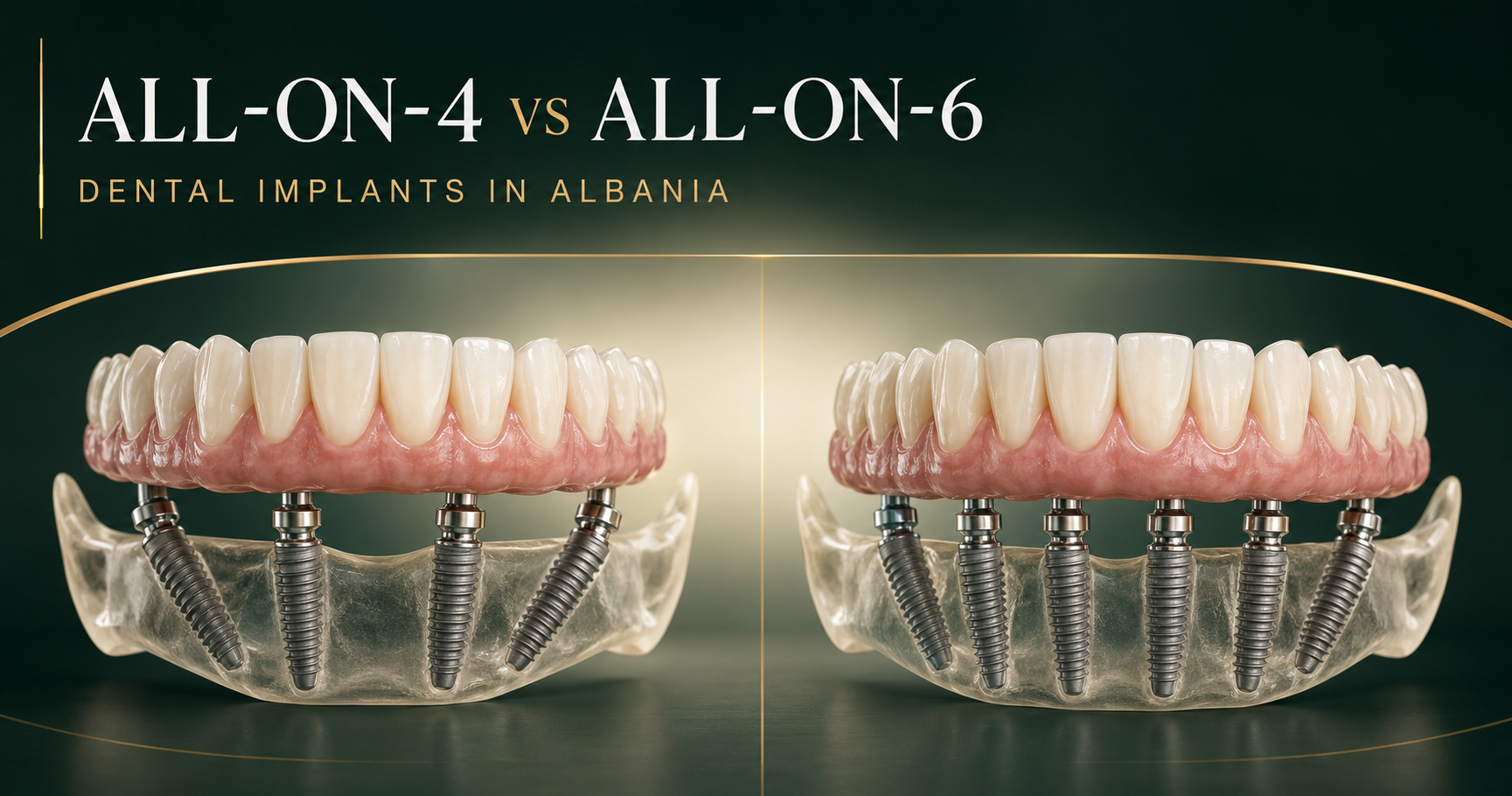
If you have lost most or all of your teeth, both All-on-4 and All-on-6 can restore a complete arch with a fixed, natural-looking dental bridge.
The main difference is the number of implants used: four for All-on-4 and six for All-on-6. However, more implants do not automatically mean a better treatment. The safest choice depends on your bone volume, jaw anatomy, bite forces, general health and the design of the final teeth.
Quick Answer
All-on-4 can be an effective solution when four well-positioned implants provide sufficient stability or when available posterior bone is limited.
All-on-6 may offer wider support and load distribution when there is enough healthy bone for six implants.
Both approaches can achieve excellent long-term outcomes when they are correctly planned. A clinical examination and a 3D CBCT scan are necessary before deciding which option is right for you.
Key Takeaways
- Both treatments replace a complete upper or lower arch with fixed teeth.
- All-on-4 uses four implants; All-on-6 uses six.
- All-on-4 may reduce the need for additional surgical procedures in selected cases.
- All-on-6 can distribute chewing forces across more implants.
- All-on-6 generally costs more because it requires two additional implants and prosthetic components.
- Neither solution is automatically suitable for every patient.
- Bone quality, implant position and prosthetic design matter more than the number alone.
What Is All-on-4?
All-on-4 is a full-arch restoration supported by four dental implants.
The two implants at the front are usually positioned vertically. The posterior implants may be angled to use the available bone more effectively and avoid important anatomical structures.
This approach can sometimes reduce the need for bone grafting, shorten treatment and make fixed full-arch rehabilitation possible for patients with reduced posterior bone.
However, All-on-4 is not a shortcut or a standard package. Implant stability, bone quality, bridge design and bite forces must all be carefully assessed.
What Is All-on-6?
All-on-6 uses six implants to support a fixed full-arch bridge.
The additional implants can provide broader support and distribute pressure across more points. This may be useful for patients with adequate bone, strong chewing forces or specific prosthetic requirements.
Because six implants require enough suitable bone and space, All-on-6 is not possible—or necessary—in every case. Some patients may require bone grafting before six implants can be safely positioned.
All-on-4 vs All-on-6: The Main Differences
| Implants per arch | Four | Six |
| Bone requirements | May work with less available posterior bone | Usually requires more suitable bone |
| Load distribution | Supported across four implants | Distributed across six implants |
| Surgery | Potentially less extensive | Two additional implant sites |
| Cost | Usually lower | Usually higher |
| Bone grafting | May sometimes be avoided | May be required if bone is insufficient |
| Best suited for | Selected patients with limited bone or specific anatomical conditions | Selected patients with adequate bone and a suitable prosthetic plan |
This comparison is general. Your individual treatment plan may differ after clinical and radiographic assessment.
What Does the Latest Scientific Evidence Say?
Recent research does not identify one universal winner.
A 2024 systematic review and meta-analysis comparing four and six implants in the upper jaw found no significant difference in implant or prosthesis survival. It did, however, report greater marginal bone loss in the four-implant group. The authors also noted limitations and variation among the available studies.
A five-year multicentre randomised clinical trial published in 2025 reported very high implant survival with both four- and six-implant maxillary restorations.
The 2026 global consensus on implant-supported full-arch treatment states that four implants represent the minimum for a fixed full-arch prosthesis, while five or six may be preferred when the anatomy and treatment plan allow.
The practical conclusion is clear: the decision should not be made by counting implants alone. Implant distribution, bone quality, prosthetic design, hygiene access and long-term maintenance are equally important.
Who May Be Suitable for All-on-4?
All-on-4 may be considered when:
- most or all teeth in one arch are missing or cannot be predictably saved;
- available posterior bone is limited;
- angled implants can be safely planned;
- four implants can achieve adequate primary stability;
- the patient wants a fixed alternative to removable dentures;
- the treatment can be designed without excessive prosthetic extension.
A CBCT scan is essential to determine whether four implants can be positioned safely.
Who May Be Suitable for All-on-6?
All-on-6 may be considered when:
- sufficient bone is available for six correctly positioned implants;
- wider implant distribution would benefit the prosthetic design;
- the patient has stronger chewing forces;
- additional support is clinically justified;
- long-term hygiene and maintenance can be managed effectively.
Placing six implants simply because “more is better” is not good treatment planning. Each implant must have a clear biological and prosthetic purpose.
How Much Do All-on-4 and All-on-6 Cost in Albania?
All-on-6 generally costs more than All-on-4 because it involves two additional implants, abutments and surgical procedures.
However, a complete price cannot be calculated from the number of implants alone. The final cost may also depend on:
- implant brand;
- temporary and final bridge;
- zirconia or alternative prosthetic material;
- extractions;
- bone grafting or sinus lift;
- surgical complexity;
- sedation or anaesthesia requirements;
- diagnostic imaging and laboratory work.
At Progonati Dental Studio, implant systems are selected according to the clinical case. Indicative individual implant prices range from approximately €350 for Anyridge, €400 for ETK, and up to €900 for Straumann. These figures should not be interpreted as the total price of a complete All-on-4 or All-on-6 restoration.
A transparent written quotation is prepared only after evaluating the teeth, bone and final prosthetic requirements.
You can also read our complete guide to dental implants in Albania or explore our implantology services.
Can You Receive Fixed Teeth Immediately?
Some patients can receive a fixed temporary bridge shortly after implant placement. This is known as immediate loading.
It is only recommended when the implants achieve sufficient initial stability and the bite can be safely controlled. The temporary bridge is designed to protect the healing implants and is not the same as the final restoration.
If immediate loading is not clinically safe, a different temporary solution may be recommended.
Myth vs Fact
Myth: Six implants are always better than four.
Fact: Six implants can offer additional support, but only when the bone, anatomy and prosthetic plan justify their use.
Myth: All-on-4 always avoids bone grafting.
Fact: It may reduce the need for grafting in selected cases, but it cannot eliminate every bone-related limitation.
Myth: Fixed full-arch implant treatment is completely maintenance-free.
Fact: Daily cleaning, professional maintenance and regular clinical checks remain essential.
Dr. Lorenc Progonati’s Advice
“The correct number of implants is not chosen from a price list. It is chosen after studying the bone, the bite and the final prosthetic design. Our goal is not simply to place more implants, but to create a restoration that is safe, functional and maintainable over time.”
At Progonati Dental Studio, full-arch treatments are planned by Dr. Lorenc Progonati using clinical examination, digital diagnostics and close collaboration with our in-house dental laboratory.
Frequently Asked Questions
Is All-on-6 more durable than All-on-4?
Not automatically. Both can be long-lasting when correctly planned and maintained. All-on-6 provides additional support, but implant position, bone health, bridge design and hygiene strongly influence durability.
Can All-on-4 be used in the upper jaw?
Yes, in selected patients. Because upper-jaw bone is often softer, careful CBCT evaluation and implant stability assessment are particularly important.
Is the procedure painful?
Surgery is performed under local anaesthetic, so pain should not be felt during implant placement. Temporary swelling and discomfort are normal afterwards and are generally manageable. Read our guide: Do dental implants hurt?.
How long does treatment take?
Many implant treatments require two phases. The first includes diagnosis, surgery and temporary rehabilitation. After a healing period—often several months—the final bridge is produced. Timing varies according to bone quality and additional procedures.
Can I choose All-on-4 because it is cheaper?
Cost matters, but it should not determine the surgical plan. The chosen solution must first be biologically and mechanically appropriate.
How can I receive a preliminary assessment from abroad?
Send us a recent panoramic X-ray or CBCT scan, photographs of your teeth and information about your health and medications. This allows our team to perform an initial remote review.
Request Your Personalised Assessment
The best solution is not always All-on-4 or always All-on-6. It is the treatment that matches your bone, bite and long-term needs.
Contact Progonati Dental Studio in Fier, Albania, and send us your panoramic X-ray or CBCT scan. Dr. Lorenc Progonati will carefully evaluate your case and explain the safest treatment options before preparing a personalised quotation.
Medically reviewed by Dr. Lorenc Progonati, Dentist and Implantologist with more than 20 years of clinical experience.
Scientific References
- Sharaf et al., 2024 – Systematic review and meta-analysis
- Toia et al., 2025 – Five-year multicentre randomised clinical trial
- First Global Consensus for Clinical Guidelines, 2026