


Dental Implant vs Dental Bridge: Which Is Better? Cost, Lifespan & Treatment in Albania (2026)
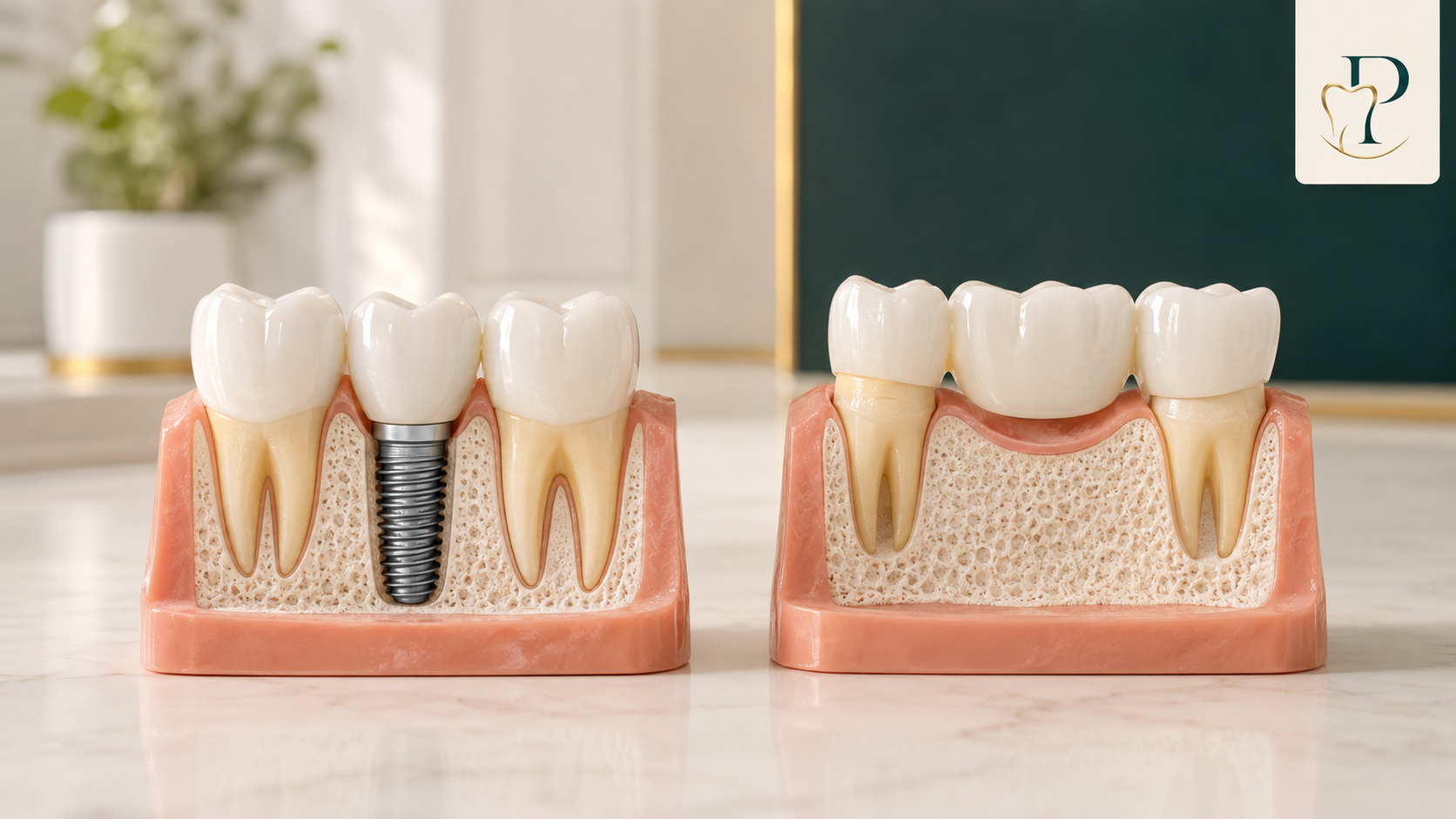
Losing a tooth affects more than the appearance of your smile. It can influence chewing, speech, confidence, bone stability and the health of the neighbouring teeth. Two of the most common solutions are a dental implant and a dental bridge—but they solve the same problem in very different ways.
So, which is better: a dental implant or a bridge?
The honest answer is that there is no universal winner. The right treatment depends on the condition of your neighbouring teeth, available bone, gum health, bite, medical history, treatment expectations and long-term priorities.
At Progonati Dental Studio, the decision is made only after a complete clinical and digital assessment—not simply by choosing the quickest or least expensive option.
A dental implant is generally the more conservative option when the neighbouring teeth are healthy because it replaces the missing tooth without preparing them. It also replaces the tooth root and can help maintain the bone in that area.
A dental bridge may be an excellent solution when the neighbouring teeth already require crowns, when implant surgery is unsuitable or when the patient wants a treatment that can usually be completed more quickly.
The best treatment is the one that protects the whole mouth—not simply the one that fills the visible gap.
- A dental implant replaces the missing tooth independently.
- A traditional bridge is supported by the teeth beside the gap.
- Implants generally require surgery and a healing period.
- Bridges can usually be completed faster.
- An implant avoids preparing healthy neighbouring teeth.
- A bridge may be appropriate when the supporting teeth already need restoration.
- Neither treatment lasts forever without good hygiene and professional maintenance.
- The total cost must be evaluated together with longevity, biological impact and future maintenance.
What is a dental implant?
A dental implant is a small biocompatible fixture, usually made of titanium, that is placed in the jawbone to replace the root of a missing tooth.
After the implant integrates with the bone, it supports:
- An abutment, which connects the implant to the restoration.
- A personalised dental crown, which recreates the visible tooth.
Unlike a traditional bridge, a single-tooth implant does not depend on the neighbouring teeth for support.
Main advantages of a dental implant
- It replaces both the visible tooth and its root.
- Healthy neighbouring teeth usually remain untouched.
- It offers stable chewing function.
- It can help preserve the bone around the missing-tooth area.
- It can provide a natural appearance when carefully planned.
- It is cleaned similarly to a natural tooth, although special attention around the implant is still necessary.
Possible limitations
- Implant placement requires a surgical procedure.
- Healing and osseointegration take time.
- Some patients may require bone grafting or another preparatory treatment.
- The initial investment is generally higher than for a bridge.
- Smoking, uncontrolled medical conditions, poor hygiene and untreated gum disease can increase the risk of complications.
What is a dental bridge?
A dental bridge replaces a missing tooth with an artificial tooth called a pontic. In a conventional three-unit bridge, the pontic is connected to crowns placed on the two neighbouring teeth.
The bridge literally spans the space created by the missing tooth.
Main advantages of a dental bridge
- It does not require implant surgery.
- Treatment can generally be completed faster.
- It can restore appearance and chewing function effectively.
- It may have a lower initial cost.
- It can be a logical option when the neighbouring teeth already have large fillings, damage or an existing need for crowns.
Possible limitations
- The neighbouring teeth must normally be prepared.
- The supporting teeth carry the load of the missing tooth.
- Cleaning beneath the artificial tooth requires special floss or interdental tools.
- Decay or gum problems affecting a supporting tooth can compromise the entire bridge.
- Because a bridge does not replace the tooth root, bone remodelling can continue beneath the missing-tooth area.
Preparing a bridge involves removing part of the enamel from the supporting teeth. Enamel does not regenerate after it has been removed, which is why the condition of the neighbouring teeth must be carefully considered before treatment.
Dental implant vs dental bridge: direct comparison
| FactorDental implantDental bridge | ||
| Support | Supported independently by the jawbone | Supported by neighbouring teeth |
| Neighbouring teeth | Usually remain untouched | Normally require preparation |
| Surgery | Yes | Usually no |
| Treatment time | Longer because healing is required | Generally faster |
| Bone preservation | Replaces the root and helps maintain local bone | Does not replace the missing root |
| Cleaning | Similar to a natural tooth, with careful implant hygiene | Requires cleaning beneath the bridge |
| Initial cost | Usually higher | Usually lower |
| Long-term value | Strong when properly selected and maintained | Depends greatly on the health of supporting teeth |
| Best suited for | Healthy adjacent teeth and sufficient bone | Adjacent teeth needing crowns or patients unsuitable for surgery |
Which option is better for the neighbouring teeth?
If both neighbouring teeth are healthy and largely untouched, a dental implant is often the more conservative solution because those teeth do not need to be reduced for crowns.
However, the situation changes when the neighbouring teeth already have:
- Large fillings
- Significant wear or fractures
- Existing crowns requiring replacement
- Severe discolouration
- Structural damage
- A genuine need for restorative treatment
In these cases, a bridge may restore the missing tooth while also treating the damaged neighbouring teeth.
This is why the answer cannot be determined from an X-ray alone. The dentist must evaluate the teeth, gums, bone, bite and long-term cleansability of the restoration.
Which lasts longer?
Both treatments can provide many years of function, but neither should be described as permanent or maintenance-free.
A systematic review reported an estimated dental implant survival rate of approximately 96.4% after ten years. Another review found an estimated ten-year survival rate of 95.2% for single implant-supported crowns. Survival, however, does not mean that every crown or component will remain unchanged indefinitely.
The lifespan of a bridge depends heavily on:
- The condition of its supporting teeth
- The quality of the preparation and fit
- The strength of the restorative material
- Oral hygiene
- Gum health
- Bite forces
- Teeth grinding or clenching
- Regular professional examinations
An implant can also develop complications, including inflammation around the implant, loosening of components, crown wear or, in some cases, loss of integration.
The European Federation of Periodontology recommends regular professional monitoring and supportive care to help prevent and manage peri-implant disease.
The most durable treatment is therefore not simply the strongest material. It is the treatment that is correctly indicated, accurately produced, easy to clean and professionally maintained.
Cost of an implant vs a bridge in Albania
A bridge usually has a lower initial price because it does not require implant surgery or a healing period. However, comparing only the starting cost can be misleading.
A complete implant treatment may include:
- Clinical examination
- 3D CBCT imaging
- Implant fixture
- Surgical placement
- Healing components
- Abutment
- Final crown
- Temporary restoration, where indicated
- Bone grafting or other additional procedures, if necessary
A bridge quotation may include:
- Preparation of the supporting teeth
- Digital impressions or scanning
- Temporary bridge
- Laboratory fabrication
- Final ceramic or zirconia bridge
- Additional treatment for supporting teeth, if clinically necessary
Important price note: Any figure shown online is indicative at the date of publication. Dental costs may change, and the final treatment plan depends on the individual clinical situation, selected materials and any additional procedures required.
At Progonati Dental Studio, implant systems are selected according to the clinical case rather than price alone. Current options may include AnyRidge, ETK and Straumann systems, while zirconia restorations are available in different material categories.
The price of the implant fixture alone should never be confused with the total cost of replacing a tooth. Patients receive a personalised written quotation after clinical and radiographic assessment.
Value is more important than the lowest price
Dental treatment should be evaluated as a long-term healthcare decision.
A less expensive treatment is not good value if it compromises healthy teeth unnecessarily, is difficult to clean or requires repeated repairs. At the same time, the most expensive option is not automatically the correct one.
True value includes:
- A correct diagnosis
- Appropriate treatment selection
- High-quality materials
- Precise digital planning
- Experienced clinical care
- Skilled laboratory work
- Natural aesthetics
- Comfortable function
- Clear maintenance instructions
- Professional follow-up
Our objective is not to sell every patient an implant. It is to recommend the solution that offers the best balance of biology, function, aesthetics and long-term maintainability.
How long does each treatment take?
Dental implant treatment time
A single dental implant usually involves several stages:
- Consultation and digital assessment
- Implant placement
- Healing and osseointegration
- Digital impression or scan
- Placement of the final crown
Healing commonly takes several months. The exact period depends on bone quality, implant stability, the treatment area and whether bone grafting is required.
In selected cases, a temporary tooth may be provided during healing. Immediate loading is not suitable for every patient and should never be promised before the clinical assessment.
International patients may therefore need two visits to Albania: one for implant placement and another for the final restoration after healing.
Dental bridge treatment time
A bridge can normally be completed more quickly because there is no implant integration period.
Treatment may include:
- Examination and planning
- Preparation of the supporting teeth
- Digital scan or impression
- Temporary bridge
- Laboratory production
- Fitting and cementation of the final bridge
The exact number of days depends on the condition of the supporting teeth, the bridge material and whether additional dental treatment is required.
Does an implant hurt more than a bridge?
Implant placement is performed under local anaesthesia, so patients should not feel sharp pain during the procedure. Mild swelling, tenderness or discomfort may occur afterwards and is normally managed with the dentist’s instructions and appropriate medication.
Bridge preparation does not involve implant surgery, but local anaesthesia is still used to keep the patient comfortable. Some temporary sensitivity may occur after the supporting teeth are prepared.
Pain should never be the only factor guiding the decision. A few days of recovery must be weighed against the long-term biological and functional consequences of each treatment.
What happens to the bone?
Natural tooth roots stimulate the surrounding jawbone. After a tooth is lost, the bone in that area can gradually remodel.
An implant transfers functional forces to the bone and can help maintain local bone volume. This does not mean that an implant prevents every form of bone loss; gum health, hygiene, implant position and long-term maintenance remain essential.
A traditional bridge replaces the visible tooth but not its root. As a result, the bone beneath the artificial tooth may continue to change over time.
If significant bone loss has already occurred, a CBCT scan can help determine whether an implant is possible and whether bone augmentation may be needed.
When might a dental implant be the better choice?
An implant may be preferable when:
- One tooth is missing.
- The neighbouring teeth are healthy.
- There is sufficient bone or bone reconstruction is possible.
- The gums are healthy.
- The patient wants an independent restoration.
- Long-term bone and tooth preservation are priorities.
- The patient can maintain excellent oral hygiene.
- There are no uncontrolled health conditions affecting healing.
When might a dental bridge be the better choice?
A bridge may be preferable when:
- The neighbouring teeth already require crowns.
- Implant surgery is medically unsuitable.
- Bone grafting would be extensive or unwanted.
- The patient wants a faster treatment.
- The anatomy of the area makes implant placement difficult.
- A well-designed bridge offers a predictable and maintainable result.
- The patient understands how to clean beneath the restoration.
When should treatment be postponed?
Neither an implant nor a bridge should be rushed when there is:
- Active gum disease
- Untreated infection
- Poor oral hygiene
- Uncontrolled diabetes or another relevant medical condition
- Heavy smoking without willingness to reduce risk
- Severe teeth grinding without protection
- An unstable bite
- Unclear diagnosis or insufficient imaging
These conditions do not always make treatment impossible, but they must be addressed as part of a responsible plan.
Cleaning and maintenance
Caring for an implant
An implant crown must be brushed carefully around the gum line. Interdental brushes, implant-safe floss or a water flosser may be recommended depending on the design.
Professional reviews allow the dentist to assess:
- Gum health
- Plaque accumulation
- Implant stability
- Bite forces
- Crown and abutment condition
- Bone levels when radiographs are clinically indicated
Caring for a bridge
A bridge cannot be cleaned like three separate teeth because the units are connected. The area beneath the artificial tooth should be cleaned using:
- Super floss
- A floss threader
- Interdental brushes
- A water flosser, when recommended
Poor cleaning around the supporting teeth can lead to decay, gum inflammation or loss of support.
For patients who grind their teeth, a protective night guard may be recommended for either treatment.
Why planning and laboratory quality matter
The success of an implant or bridge depends on much more than the material name.
Accurate planning must consider:
- Tooth position
- Gum shape
- Bone volume
- Smile line
- Bite forces
- Crown proportions
- Contact points
- Cleaning access
- Colour and translucency
Progonati Dental Studio combines clinical treatment, digital dentistry and in-house laboratory collaboration. This allows communication between the dentist and dental technicians throughout the planning, design and production stages.
The objective is a restoration that does not merely look attractive in a photograph, but also fits accurately, functions comfortably and can be maintained over time.
Common myths
“An implant is always better.”
Not always. It may be the more conservative choice beside healthy teeth, but a bridge can be appropriate when the neighbouring teeth already need crowns or surgery is unsuitable.
“A bridge damages the neighbouring teeth.”
A bridge requires their preparation, but this does not automatically make it poor treatment. The key question is whether preparing those teeth is clinically justified.
“Implants last forever.”
Implants have strong long-term survival rates, but they can develop biological or mechanical complications. Hygiene and professional follow-up remain essential.
“The cheapest treatment saves the most money.”
Not necessarily. Future maintenance, supporting-tooth health, repairs and replacement must also be considered.
“If there is little bone, an implant is impossible.”
Not always. Bone grafting, sinus augmentation or alternative implant strategies may be considered after a CBCT assessment. However, these procedures are not appropriate for every patient.
Frequently asked questions
Is an implant better than a bridge for one missing tooth?
When the neighbouring teeth are healthy and sufficient bone is available, an implant is often the more conservative option. A bridge may be preferable if the neighbouring teeth already need crowns or surgery is unsuitable.
Which treatment looks more natural?
Both can look natural when correctly planned and produced. The final appearance depends on gum architecture, material selection, crown proportions, laboratory craftsmanship and the condition of the surrounding teeth.
Which treatment is faster?
A bridge is usually faster because it does not require the implant to integrate with the bone.
Which treatment is less expensive?
A bridge often costs less initially. An implant usually requires a higher upfront investment but avoids preparing healthy neighbouring teeth and may offer strong long-term value.
Can a bridge be replaced with an implant later?
In many cases, yes. However, the condition of the supporting teeth and available bone must be reassessed. Bone grafting may be necessary if significant resorption has occurred.
Can I have an implant immediately after extraction?
Sometimes. Immediate implant placement depends on infection control, bone anatomy, gum condition and the ability to achieve adequate implant stability.
Will I be without a tooth during implant healing?
Not necessarily. Depending on the location and clinical situation, a temporary removable or fixed restoration may be provided.
How many trips to Albania are needed?
A bridge may often be completed during one planned visit. Implant treatment commonly requires one visit for placement and another after healing for the final crown. The schedule is personalised for every international patient.
Dental implant or bridge: our conclusion
A dental implant is often the preferred solution when the neighbouring teeth are healthy, adequate bone is present and the patient wants an independent tooth replacement.
A dental bridge remains a valuable treatment when the supporting teeth already require restoration, surgery is not appropriate or a faster fixed solution is preferred.
The correct question is not simply:
“Which treatment is cheaper?”
It is:
“Which solution protects my oral health, functions comfortably and offers the greatest long-term value in my individual case?”
Request your personalised assessment
If you are considering a dental implant or bridge in Albania, Progonati Dental Studio can review your case before you travel.
Send us:
- A recent panoramic X-ray or CBCT scan, if available
- Clear photographs of your teeth and smile
- A short description of your concerns
- Relevant medical information
- Any previous treatment plans
Our team can provide an initial remote assessment and explain the possible treatment options. A final diagnosis and written quotation are provided after the necessary clinical and radiographic examination.
Contact Progonati Dental Studio in Fier, Albania, to request your consultation and personalised treatment plan.
Scientific references
- Long-term dental implant survival: systematic review and meta-analysis
- Five- and ten-year survival of single implant-supported crowns
- Survival of implant-supported fixed dental prostheses
- European Federation of Periodontology guideline on peri-implant diseases
- Dental bridge vs implant overview – Cleveland Clinic
This article provides general educational information and does not replace an individual dental examination, diagnosis or treatment plan. Results, suitability, treatment duration and costs vary according to each patient’s clinical condition.