


Root Canal vs Tooth Extraction: Which Is Better? Pain, Cost, Recovery & Treatment in Albania (2026)
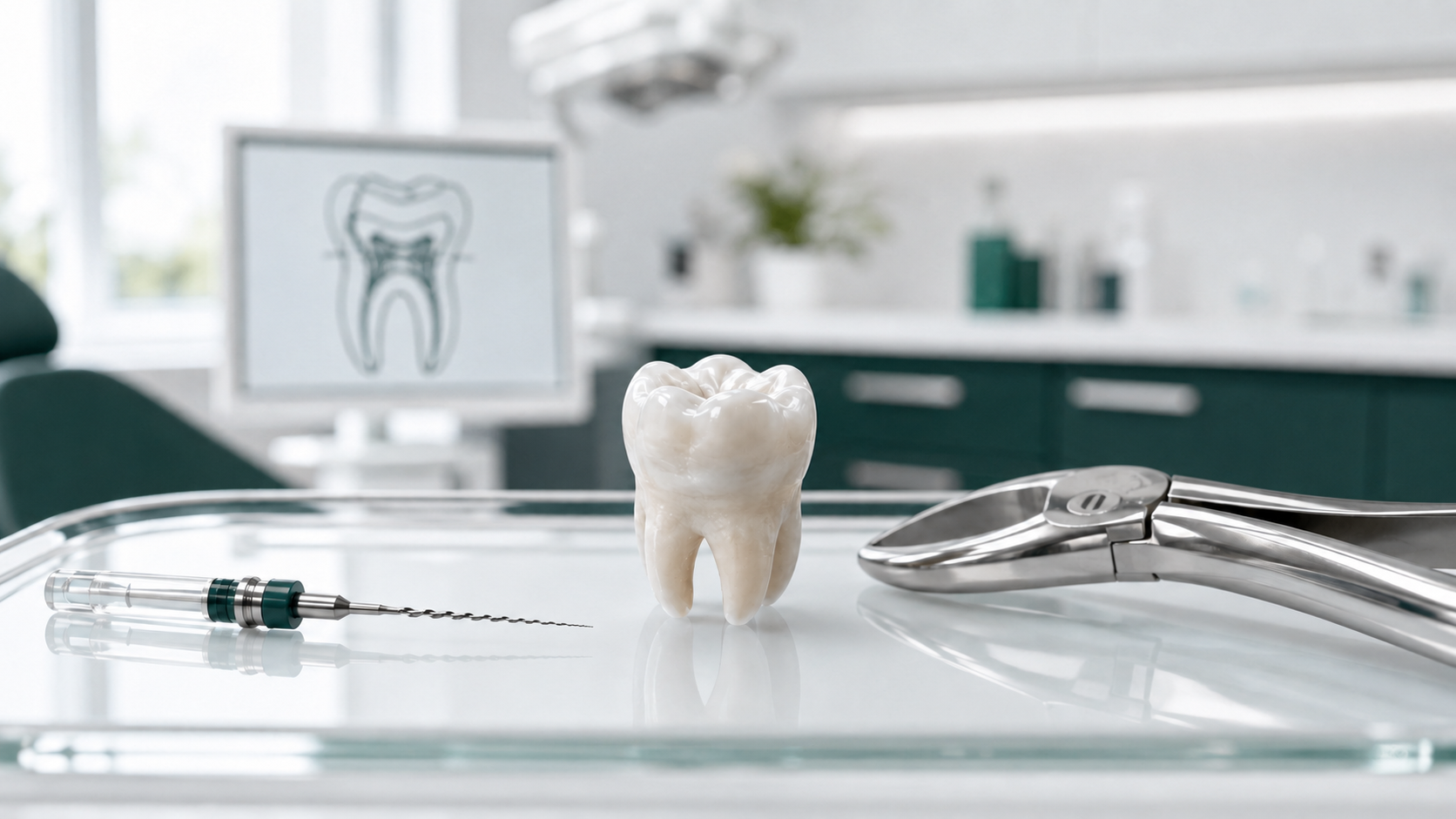
A severely damaged or infected tooth does not always need to be removed. In many cases, root canal treatment can eliminate the infection, relieve pain and preserve the natural tooth. However, when a tooth is fractured beyond repair, has insufficient healthy structure or has lost too much periodontal support, extraction may be the safer and more predictable option.
The correct decision cannot be made from symptoms alone. It requires a clinical examination, dental X-rays and an assessment of the tooth, roots, surrounding bone, gums and future restorative possibilities.
In this guide, we explain the differences between root canal treatment and tooth extraction, including pain, costs, recovery, long-term consequences and the clinical factors dentists consider before recommending treatment.
Root Canal or Tooth Extraction?
When a tooth can be restored and has a reasonable long-term prognosis, preserving it with root canal treatment is generally preferred. Keeping the natural tooth helps maintain normal chewing, appearance and the relationship between neighbouring teeth.
Extraction may be recommended when the tooth cannot be predictably repaired—for example, because of a severe fracture, extensive decay below the gum line, advanced periodontal bone loss or another condition that makes long-term restoration unrealistic.
A root canal saves the existing tooth. An extraction removes it permanently and may create the need for a dental implant, bridge or removable replacement.
The best option is therefore not automatically the fastest or least expensive procedure. It is the treatment most likely to provide a healthy, functional and maintainable result over time.
- Root canal treatment removes inflamed or infected tissue from inside the tooth while preserving the natural root and crown structure that can still be restored.
- Tooth extraction removes the entire tooth and is irreversible.
- Modern root canal treatment and tooth extraction are normally performed under local anaesthesia.
- Extraction may appear less expensive initially, but replacing the missing tooth can increase the total treatment cost.
- A root-treated tooth may need a strong final restoration, such as an onlay or crown.
- Not every painful tooth requires root canal treatment, and not every badly damaged tooth can be saved.
- The decision should be based on clinical tests, dental imaging, remaining tooth structure, periodontal support and the expected long-term prognosis.
- Severe swelling, fever or difficulty breathing or swallowing requires urgent medical assessment.
Root Canal vs Tooth Extraction: Main Differences
| FactorRoot canal treatmentTooth extraction | ||
| Main objective | Eliminate infection and preserve the natural tooth | Remove a tooth that cannot or should not be retained |
| What happens to the tooth? | The tooth remains in the mouth | The entire tooth is removed |
| Anaesthesia | Usually local anaesthesia | Usually local anaesthesia |
| Treatment stages | Cleaning, disinfecting, filling and sealing the canals, followed by final restoration | Removal of the tooth, healing and possible tooth replacement |
| Recovery | Mild tenderness may occur for several days | Pain, swelling and sensitivity are common during early healing |
| Future treatment | A filling, onlay or crown may be required | An implant, bridge or removable prosthesis may be considered |
| Initial cost | Depends on the tooth, number of canals and restoration | Often lower for a straightforward extraction |
| Total long-term cost | Includes root canal treatment and final restoration | May include extraction, bone management and replacement of the missing tooth |
| Main advantage | Preserves the natural tooth | Removes a tooth with a poor or hopeless prognosis |
| Main limitation | The tooth must still be restorable | The procedure is irreversible and leaves a space |
This comparison is general. An individual diagnosis may reveal additional factors that change the treatment plan.
What Is Root Canal Treatment?
Root canal treatment—also known as endodontic treatment—is performed when the dental pulp inside a tooth becomes severely inflamed, infected or necrotic.
The pulp contains nerves, blood vessels and connective tissue. It may be damaged by:
- deep dental decay;
- cracks or fractures;
- repeated dental procedures;
- leakage beneath an old filling or crown;
- dental trauma;
- infection at the tip of the root.
During root canal treatment, the dentist creates access to the pulp chamber, removes the diseased tissue and carefully cleans, shapes and disinfects the root canal system. The canals are then filled and sealed to reduce the risk of reinfection.
The tooth is not “removed” or replaced by an artificial tooth. Its natural roots remain in the jaw, and the visible part is restored so that it can continue to function.
The purpose of treatment is to control the infection, relieve symptoms and preserve a functional natural tooth.
When May Root Canal Treatment Be Recommended?
Root canal treatment may be considered when:
- decay has reached or severely irritated the pulp;
- a tooth causes spontaneous or persistent pain;
- sensitivity to hot or cold lingers after the stimulus is removed;
- the tooth is painful when biting or chewing;
- the pulp has died following trauma;
- an infection or abscess has developed around the root;
- an old root canal requires retreatment;
- the tooth is cracked but remains structurally restorable;
- the tooth is needed to support a wider restorative plan.
Symptoms alone do not confirm the diagnosis. Some infected teeth cause little or no pain, while pain can also arise from the gums, jaw muscles, sinuses or another tooth.
The dentist may use cold or heat tests, percussion, palpation, bite tests and dental X-rays to determine the condition of the pulp and surrounding tissues.
When Is Tooth Extraction the Better Option?
Saving the natural tooth is valuable, but it is not always possible or clinically responsible.
Extraction may be recommended when:
- the tooth has a vertical root fracture;
- decay extends so deeply that the tooth cannot be predictably restored;
- too little healthy tooth structure remains to support a restoration;
- the fracture extends far below the gum or bone level;
- severe periodontal disease has destroyed much of the tooth’s support;
- the tooth is extremely mobile because of advanced bone loss;
- repeated endodontic treatment has failed and further treatment has a poor prognosis;
- extensive root resorption has compromised the tooth;
- the tooth’s position prevents a functional restoration;
- retaining the tooth would interfere with a safer overall treatment plan.
Extraction should not be chosen only because it is faster. Likewise, root canal treatment should not be performed on a tooth that cannot later be restored and maintained.
The important question is not simply, “Can the canals be treated?” It is, “Can the entire tooth be restored to function safely after treatment?”
Does Root Canal Treatment Hurt?
Root canal treatment has a reputation for being painful, but much of that fear comes from the pain caused by the infection before treatment.
The procedure is normally performed under local anaesthesia. During treatment, the patient may feel pressure, vibration or movement, but sharp pain should be reported immediately so that anaesthesia can be reassessed.
After the appointment, the tooth may feel tender when biting or touching it. Mild discomfort often improves within several days. The American Association of Endodontists notes that symptoms in most cases improve within approximately three to five days.
Increasing pain, swelling, fever, a change in the bite or symptoms that do not improve should be reported to the treating dentist.
Does Tooth Extraction Hurt?
Tooth extraction is also normally carried out under local anaesthesia. The patient may feel pressure and movement, but the objective is to prevent sharp pain during the procedure.
After extraction, some discomfort, bleeding and swelling are expected. Pain is often more noticeable during the first two or three days and should then begin to improve.
Recovery depends on:
- which tooth was removed;
- whether the extraction was simple or surgical;
- the presence of infection;
- the shape and number of roots;
- the patient’s health;
- smoking;
- compliance with postoperative instructions.
A blood clot forms inside the socket and protects the healing tissues. Vigorous rinsing, smoking or disturbing the area can dislodge this clot and increase the risk of dry socket.
Dry socket typically causes increasing, throbbing pain several days after extraction, sometimes accompanied by an unpleasant taste or bad breath. It requires professional assessment and treatment.
Root Canal or Extraction: Which Has the Easier Recovery?
Recovery after root canal treatment is usually limited to temporary sensitivity around the treated tooth. Patients can often return to normal daily activities quickly, although chewing on the tooth may need to be limited until the final restoration is completed.
Extraction creates a healing wound. Patients may need to modify eating, brushing and physical activity while the blood clot and socket remain vulnerable.
General instructions after extraction may include:
- biting gently on gauze as directed;
- avoiding vigorous rinsing on the day of surgery;
- choosing soft foods initially;
- avoiding smoking;
- not touching the socket;
- brushing carefully around the area;
- following personalised medication instructions;
- contacting the clinic if bleeding, pain or swelling becomes worse.
The dentist will provide instructions appropriate to the specific procedure. Generic online advice should never replace those instructions.
Will I Need a Crown After Root Canal Treatment?
Not every root-treated tooth automatically requires the same restoration.
The decision depends on:
- the tooth’s position;
- how much healthy structure remains;
- the size of existing fillings;
- whether the tooth is cracked;
- the patient’s bite;
- chewing forces;
- aesthetic requirements.
Molars and premolars are exposed to significant chewing forces and frequently require cuspal coverage with an onlay or crown. Front teeth with sufficient remaining structure may sometimes be restored differently.
The final restoration is a critical part of treatment. Even a technically successful root canal may have a poor long-term outcome if the tooth is not sealed and protected appropriately.
At Progonati Dental Studio, restorative planning can be coordinated with our in-house dental laboratory. When a crown is indicated, the material and design are selected according to the remaining tooth structure, position, bite and aesthetic needs.
You can also read our complete guide to zirconia crowns in Albania.
What Happens After a Tooth Is Extracted?
After extraction, the dentist evaluates whether the missing tooth should be replaced.
Possible options include:
- A dental implant and crown.
- A traditional dental bridge.
- A removable partial denture.
- Orthodontic space closure in selected cases.
- Leaving the space untreated when replacement is not clinically necessary.
The correct option depends on the tooth’s location, neighbouring teeth, bone volume, gum health, bite, age, medical history and the patient’s preferences.
Not every extracted tooth needs an implant. Wisdom teeth, for example, are generally not replaced. However, losing a functional tooth may affect chewing, neighbouring teeth and the distribution of bite forces.
If an implant is being considered, the dentist may assess whether it can be placed immediately or whether the site should heal first. Immediate implant placement is possible only in selected cases and does not automatically mean that the final crown can be delivered on the same day.
Learn more in our complete guide to dental implants in Albania.
Which Is More Expensive: Root Canal or Extraction?
A straightforward extraction is often less expensive than root canal treatment at the first appointment. However, this comparison is incomplete if the missing tooth will later be replaced.
Root canal costs may include:
- diagnostic examination and dental imaging;
- treatment of the root canal system;
- temporary or permanent filling;
- reconstruction of lost tooth structure;
- an onlay or crown;
- follow-up examinations.
Extraction and replacement costs may include:
- extraction;
- surgical extraction when necessary;
- management of the socket;
- bone preservation or grafting in selected cases;
- a dental implant and abutment;
- an implant crown;
- a bridge or removable prosthesis;
- additional visits and healing time.
For this reason, patients should compare the complete treatment pathways rather than the price of root canal treatment with the price of extraction alone.
At Progonati Dental Studio, the final quotation is prepared after the tooth has been examined and its prognosis assessed. Treatment cost can vary according to the tooth, canal anatomy, infection, complexity and type of final restoration.
How Long Does Each Treatment Take?
Root canal treatment may be completed in one or more appointments, depending on:
- the number and complexity of the canals;
- whether the tooth has been treated before;
- the presence of infection;
- symptoms between visits;
- whether additional restorative treatment is required.
A final filling, onlay or crown may be completed at a separate appointment.
Extraction may be relatively quick when the tooth is fully visible and has uncomplicated roots. Surgical extraction can take longer when the tooth is fractured, impacted or difficult to access.
If the missing tooth will be replaced with an implant, the complete process may involve additional healing and restorative stages. Treatment times should therefore be discussed for the entire plan—not only for the day of extraction.
Can a Root Canal Fail?
Root canal treatment has a strong clinical record, but no dental treatment can be guaranteed for life.
A root-treated tooth can develop new problems because of:
- untreated or difficult-to-access anatomy;
- leakage beneath a filling or crown;
- new decay;
- delayed placement of the final restoration;
- fracture;
- reinfection;
- periodontal disease;
- excessive bite forces.
Failure does not automatically mean that the tooth must be extracted. Depending on the cause, treatment options may include:
- nonsurgical root canal retreatment;
- root-end surgery;
- replacement of a leaking restoration;
- periodontal treatment;
- extraction when the prognosis is no longer favourable.
Recent comparative evidence indicates that both properly treated natural teeth and dental implants can achieve high survival rates. The choice should be individualised rather than assuming that an implant is automatically superior to a restorable natural tooth.
Is an Implant Better Than a Root-Treated Tooth?
An implant is an excellent solution for replacing a tooth that is already missing or cannot be saved. It is not automatically a better alternative to every tooth that needs root canal treatment.
A natural tooth retains its periodontal ligament, natural sensation and biological relationship with the surrounding tissues. An implant is an artificial replacement that also requires healthy tissues, correct positioning, professional maintenance and daily cleaning.
The decision should consider:
- whether the tooth is restorable;
- periodontal support;
- root condition;
- presence and type of fracture;
- expected endodontic prognosis;
- quality of neighbouring teeth;
- bone availability;
- bite forces;
- medical history;
- smoking;
- treatment time;
- patient preference.
When both options are clinically reasonable, the dentist should explain their advantages, limitations, costs and expected maintenance before the patient makes a decision.
Root Canal vs Extraction: Common Myths
Myth: An infected tooth must always be extracted
Fact: Many infected teeth can be treated successfully with root canal treatment when they remain restorable.
Myth: Root canal treatment removes the tooth
Fact: Root canal treatment removes diseased tissue from inside the tooth. The natural tooth remains in place.
Myth: Extraction permanently solves every problem
Fact: Extraction removes the affected tooth, but the space, surrounding bone and future replacement still require consideration.
Myth: An implant is always better than a natural tooth
Fact: Implants are valuable replacements for missing or non-restorable teeth. A restorable natural tooth should be evaluated carefully before extraction.
Myth: If a tooth no longer hurts, the infection has disappeared
Fact: A tooth may stop hurting when the pulp becomes necrotic, while infection can remain around the root.
Myth: Antibiotics can replace root canal treatment
Fact: Antibiotics alone do not remove infected tissue from inside the root canal. They may be prescribed in particular circumstances, such as spreading infection or systemic involvement, but definitive dental treatment is still required.
Warning Signs That Require Prompt Dental Assessment
Arrange a dental examination if you experience:
- persistent or severe toothache;
- prolonged sensitivity to hot or cold;
- pain when biting;
- swelling of the gum or face;
- a pimple-like swelling on the gum;
- pus or an unpleasant taste;
- a darkened tooth after trauma;
- a broken or deeply decayed tooth;
- a loose tooth;
- recurring pain beneath an old filling or crown.
Seek urgent medical help if swelling makes it difficult to breathe, swallow or speak, spreads towards the eye, becomes extensive or prevents you from opening your mouth properly. These can be signs of a serious spreading infection. NHS guidance on dental abscesses
Root Canal and Tooth Extraction at Progonati Dental Studio
At Progonati Dental Studio in Fier, every decision begins with diagnosis.
Before recommending root canal treatment or extraction, Dr. Lorenc Progonati evaluates:
- the source of the pain or infection;
- remaining healthy tooth structure;
- root anatomy and condition;
- surrounding bone and gums;
- cracks or fractures;
- previous treatment;
- bite and functional demands;
- the possibility of restoring the tooth;
- alternative treatment options;
- the patient’s overall dental plan.
Our objective is not to preserve a tooth at any cost or remove it simply because extraction is faster. The objective is to recommend the option that offers the most responsible balance of health, function, comfort and long-term maintainability.
When a crown or implant restoration is required, our in-house dental laboratory allows direct coordination between clinical treatment and prosthetic design.
International patients may send recent dental X-rays and clear photographs for an initial remote assessment. However, the final diagnosis and treatment plan can only be confirmed after an in-person clinical examination and appropriate imaging.
Frequently Asked Questions
Is it better to have a root canal or remove the tooth?
If the tooth is restorable and has a reasonable prognosis, preserving it with root canal treatment is usually preferred. Extraction may be the better option when the tooth is fractured or damaged beyond predictable repair.
How does the dentist decide whether a tooth can be saved?
The dentist evaluates the remaining tooth structure, roots, cracks, decay, periodontal support, infection, bite and ability to place a durable final restoration. Clinical tests and dental X-rays are essential.
Is root canal treatment more painful than extraction?
Both procedures are normally performed under local anaesthesia. Root canal treatment may cause temporary tenderness, while extraction creates a surgical wound that can cause pain and swelling during early healing.
How long does discomfort last after a root canal?
Mild tenderness commonly improves within several days. Increasing pain, swelling or symptoms that do not improve should be evaluated.
How long does extraction recovery take?
Pain and swelling are commonly greatest during the first few days. The gum and socket continue healing over the following weeks. Recovery varies according to the tooth, procedure and individual patient.
Does every root-treated tooth need a crown?
No. The restoration depends on the tooth and how much structure remains. Posterior teeth and heavily weakened teeth frequently need an onlay or crown for protection.
Can an infected tooth be treated without antibiotics?
Many localised dental infections are treated by removing the source through root canal treatment or drainage. Antibiotics are not automatically required in every case. The dentist decides based on swelling, spread of infection, systemic symptoms and medical history.
Can a root canal infection return?
Yes. Reinfection may occur because of leakage, new decay, complex canal anatomy, fracture or other factors. Retreatment may be possible in selected cases.
Can an implant be placed immediately after extraction?
Sometimes, but only when clinical conditions are suitable. Infection, bone condition, gum tissues, implant stability and the final restorative plan must all be assessed.
What should international patients send for an initial assessment?
You may send a recent panoramic X-ray, any available detailed dental X-rays or CBCT images, clear photographs and information about symptoms, previous treatment, medical conditions and medication. Additional imaging may still be required at the clinic.
Request a Personalised Assessment
If you have been told that a tooth needs root canal treatment or extraction, you deserve to understand why.
Contact Progonati Dental Studio for an initial consultation. Dr. Lorenc Progonati will assess whether the tooth can be predictably preserved, explain the available alternatives and prepare a transparent treatment plan based on your individual clinical situation.
The best treatment is not always the quickest one. It is the one that protects your health, function and confidence over the long term.
This article provides general educational information and does not replace a clinical examination, diagnosis or personalised medical advice.
Scientific and Professional Sources
- European Society of Endodontology – S3 Clinical Practice Guidelines for Pulpal and Apical Disease
- American Association of Endodontists – Root Canal vs Extraction
- American Association of Endodontists – What Is Root Canal Treatment?
- Comparative Outcomes of Endodontically Treated Teeth and Dental Implant-Supported Prostheses – Systematic Review
- NHS – Dental Surgery and Recovery
- NHS – Dental Abscess: Symptoms and Emergency Guidance